What Is Identity Verification and How Is It Changing the Way Businesses Operate?
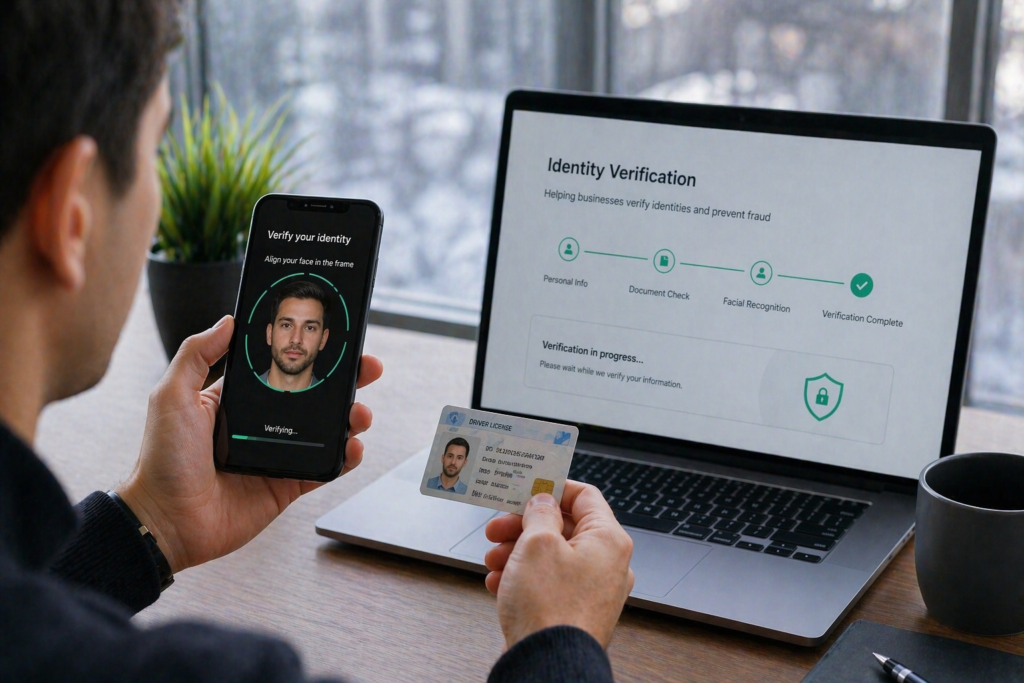
Every time you sign up for a new app, open a bank account online, or verify your age on a platform, something is happening in the background that most people never think about. A system is checking whether you are who you say you are. It is comparing your face to your documents, scanning your ID for signs of tampering, and cross-referencing your details against trusted databases, all in the time it takes to make a cup of coffee.
This process is called identity verification, and it has quietly become one of the most important technologies powering the modern digital economy. Businesses across every major industry now depend on it to onboard customers safely, meet legal obligations, and protect themselves from increasingly sophisticated fraud. Yet most people have little idea how it actually works, or just how much is at stake when it fails.
This guide breaks down what identity verification is, how the technology functions, where it is being used, and why companies of all sizes are investing in it right now.
What Is Identity Verification?
Identity verification commonly referred to as IDV, is the process of confirming that a person’s stated identity is genuine and belongs to them. In the simplest possible terms, it answers one foundational question: Is this person really who they claim to be?
For most of human history, this question was answered in person. A bank employee would look at your driver’s license, compare your face to the photo, and make a judgment call. The process was human, slow, and fallible. A persuasive demeanor or a convincing-looking fake ID could sometimes be enough to slip through.
Digital identity verification has changed all of that. Today, advanced identity verification software can analyse a submitted document in seconds, checking it against thousands of known templates, examining it for signs of digital manipulation, and verifying security features that no human eye could consistently detect. It then matches the document to the face of the person submitting it using biometric technology and does all of this at scale, around the clock, without fatigue or inconsistency.
This shift from manual to automated verification is not just a technological upgrade. It represents a fundamental change in how trust is established online, and it underpins billions of transactions and onboarding events every year.
Why Identity Verification Matters More Than Ever
The growth of online services has created extraordinary convenience, but it has also created a much larger attack surface for fraud. Identity theft is now one of the most reported financial crimes globally. Criminals obtain stolen personal data through phishing attacks, data breaches, and social engineering, then use that information to impersonate real people, opening fraudulent accounts, applying for credit, making purchases, and laundering money through seemingly legitimate platforms.
One of the key enablers of this fraud is the fake ID. Digital forgery tools have advanced to the point where convincing counterfeit identity documents can be produced without any specialist skills. When a business relies on manual document checks or basic image uploads without any deeper analysis, these fakes can pass undetected with serious financial and legal consequences for everyone involved.
The business case for strong identity verification is straightforward. Every fraudulent account that is opened represents a financial loss, a potential regulatory violation, and a reputational risk. When a platform is used to launder money or commit financial crime, the platform itself may face legal liability. The cost of prevention, investing in a capable identity verification solution, is almost always a fraction of the cost of the fraud it prevents.
Beyond the immediate financial calculation, there is also the question of customer trust. People want to know that the platforms they use are taking their security seriously. A business that visibly invests in rigorous identity checks signals that it takes its responsibilities seriously, which builds the kind of trust that turns one-time users into long-term customers.
How Identity Verification Works: A Step-by-Step Look
Modern identity verification platforms operate through several interconnected layers of checks. Each stage adds a level of confidence, and together they create a verification result that is both reliable and auditable. Here is how the process typically unfolds.
Step One: Document Capture and Authenticity Analysis
The user submits a photograph or scan of their identity document, which could be a passport, driver’s license, national ID card, or residence permit. The identity verification software then analyses the document on multiple levels simultaneously.
Optical character recognition (OCR) extracts the readable data from the document name, date of birth, document number, and expiry date. At the same time, the system performs a detailed visual analysis, checking the document against a library of known templates from countries worldwide. It looks for inconsistencies in font spacing and weight, checks the integrity of machine-readable zones, verifies embedded security features like holograms and watermarks, and flags any signs of digital editing at the pixel level.
This document-level analysis is where many fraudulent attempts are caught. A document may look convincing to the human eye but contain dozens of microscopic inconsistencies that an AI-powered system detects instantly.
Step Two: Biometric Matching and Liveness Detection
Once the document passes its checks, the system moves to confirming that the person submitting it is its legitimate owner. The user is prompted to take a selfie or complete a short face-scan task. Facial recognition technology compares this live image to the photograph embedded in the document and generates a confidence score for the match.
Critically, modern systems also apply liveness detection, a technology that verifies the submitted image is from a real, live person rather than a photograph, video replay, or AI-generated deepfake. This is increasingly important as deepfake technology becomes more accessible. High-quality liveness detection is now a standard expectation in any serious ID verification solution.
Step Three: Database and Watchlist Checks
The final stage expands the verification beyond the document and the face. The extracted identity data is checked against third-party sources, including government databases, sanctions lists, politically exposed person (PEP) registries, and adverse media sources.
For businesses with anti-money laundering obligations, this stage is what transforms basic IDV into a comprehensive compliance function. It creates an auditable record that regulators can review and that the business can rely on if questions are ever raised about its due diligence.
Who Is Using Identity Verification Services and Why
The adoption of identity verification services has spread across virtually every sector where digital onboarding or age-gating is required. Here is a look at the industries where IDV has become a core operational requirement.
Financial Services: Banks, credit unions, fintech startups, and investment platforms all face strict Know Your Customer (KYC) requirements. A robust ID verification tool is not optional in this space; it is the foundation of every compliant customer relationship.
Cryptocurrency and Web3: Crypto exchanges and digital asset platforms are now subject to the same anti-money laundering regulations as traditional financial institutions in most major jurisdictions. Digital identity verification is central to their compliance architecture.
Online Gambling and Gaming: Age verification is a legal requirement for licensed gambling operators globally. Platforms that fail to prevent underage access face fines, loss of licenses, and serious reputational damage. IDV provides the rapid, reliable check that makes this manageable at scale.
Gig Economy and Marketplaces: Platforms connecting freelancers, drivers, and service providers with customers need to verify that participants are who they say they are. Background checks and identity checks go hand-in-hand in creating safe, trusted marketplace environments.
Healthcare: Telehealth platforms and online pharmacy services verify patient identity to protect patient safety, prevent the misuse of prescriptions, and comply with healthcare regulations governing remote service delivery.
HR and Remote Employment: Employers must confirm the right to work for every new hire. In a world where remote hiring is standard, digital identity verification has replaced the old requirement for in-person document inspection.
The Regulatory Side: Why Compliance Is Driving Adoption
Regulation is one of the strongest forces behind the widespread adoption of identity verification across industries. In the United Kingdom, the Financial Conduct Authority requires every authorised financial firm to implement Know Your Customer processes as part of its Anti-Money Laundering obligations. The Money Laundering, Terrorist Financing and Transfer of Funds Regulations set out a legal framework that firms must meet before establishing customer relationships and when monitoring ongoing activity for suspicious behavior.
The Financial Conduct Authority does not mandate a specific technical approach to verification, but it does expect firms to demonstrate that their processes are proportionate, risk-based, and consistently applied. A business that relies on ad-hoc manual checks, with no documented process and no audit trail, would have difficulty meeting this standard under scrutiny.
In the United States, the Bank Secrecy Act and FinCEN’s Customer Due Diligence rules create equivalent obligations for financial institutions. The EU’s Anti-Money Laundering Directives impose similar requirements across member states. For companies operating across multiple jurisdictions, a well-designed identity verification platform needs to support compliance with this patchwork of overlapping regulations, which is one reason why businesses increasingly prefer established, specialist providers over building verification infrastructure from scratch.
Data privacy is another regulatory dimension. Any system that collects biometric data, facial images, for example, must comply with applicable privacy regulations, whether that is GDPR in Europe, CCPA in California, or other state and federal frameworks in the US. The best identity verification platforms are built with privacy compliance as a core design principle, not an afterthought.
What Businesses Should Look for When Adopting an Identity Verification Platform
As the market for identity verification services has matured, the range of available solutions has grown substantially. For businesses evaluating their options, several factors stand out as particularly important.
- Global document coverage: A platform that can verify documents from a wide range of countries is essential for any business with an international customer base.
- Liveness detection quality: As deepfake fraud grows, the sophistication of a provider’s anti-spoofing technology becomes a meaningful differentiator.
- API flexibility: A well-designed Identity Verification API allows development teams to integrate checks smoothly into existing customer journeys without rebuilding entire systems from the ground up.
- Compliance breadth: The best platforms actively track regulatory changes across jurisdictions and update their check processes accordingly, reducing the internal compliance burden.
- Accuracy and speed: Verification that is slow or that fails legitimate customers at a high rate creates friction that damages conversion and customer experience. The balance between security rigour and user experience matters.
The market spans enterprise-grade providers with deep compliance capabilities and leaner, API-first tools designed for fast-moving startups. The right choice depends on the volume of verifications needed, the regulatory environment the business operates in, and the technical resources available to manage integration.
Conclusion
Identity verification has grown from a back-office compliance checkbox into a strategic technology that touches every part of how modern businesses build and maintain trust. Whether a company is onboarding its first customer or its ten millionth, the ability to confirm identity accurately, quickly, securely, and in a way that satisfies both regulators and real people is now a fundamental requirement.
The fraud landscape is not getting simpler. Deepfakes, synthetic identities, and increasingly convincing fake IDs mean that the standards businesses are held to will continue to rise. The companies that treat digital identity verification as a core investment rather than a reluctant compliance cost are the ones that will be best positioned to grow confidently, protect their customers, and earn the kind of long-term trust that no marketing budget can manufacture.
In the digital economy, knowing who you are dealing with is everything. And identity verification is how that knowledge is built.













Post Comment