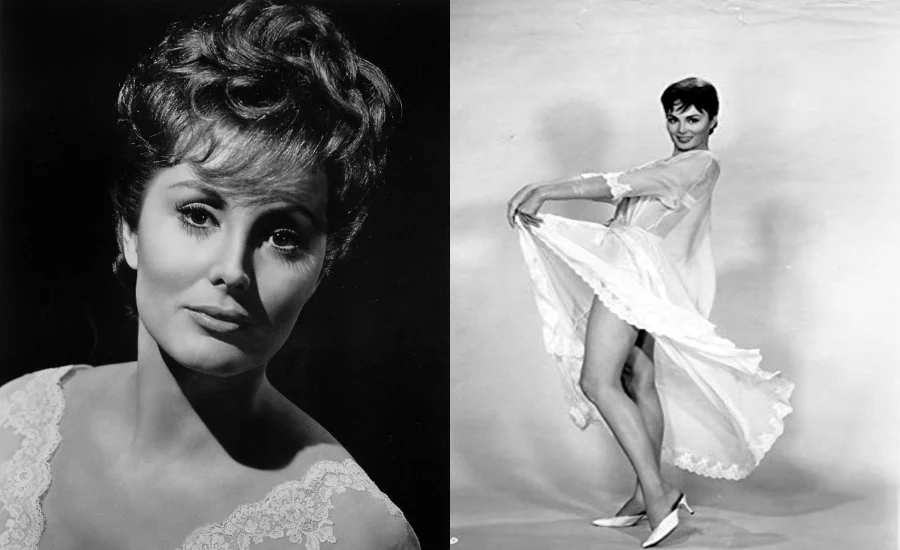
Charlene Holt: The Actress Howard Hawks Discovered in a Lipstick Commercial
The story of how Charlene Holt entered the film industry is the kind of thing that sounds invented a legendary Hollywood director watching a television commercial, freezing mid-thought, and picking up the phone to change a woman’s entire life trajectory. That director was Howard Hawks. The commercial was for Revlon lipstick. And the woman on screen was someone who had spent years building a modeling career so polished and so formidable that it finally became impossible to ignore, even from the highest perches of the industry.
What makes Charlene Holt’s story genuinely riveting, sixty years later, is how much of it happened quietly. She moved through the world of beauty pageants, fashion modeling, and eventually Hollywood with a kind of composed elegance that photographers loved and directors trusted. She wasn’t manufacturing a persona. She simply was with unusual completeness exactly what the camera wanted to find.
Quick Bio
| Detail | Info |
|---|---|
| Birth Name | Verna Charlene Stavely |
| Stage Name | Charlene Holt |
| Date of Birth | April 28, 1928 |
| Birthplace | Snyder, Texas, USA |
| Zodiac Sign | Taurus |
| Nationality | American |
| Parents | Malcolm C. Stavely & Verna Vesta Stavely (née Chandler) |
| High School | Graduated in Hagerman, New Mexico |
| University | McMurry University, Abilene, Texas |
| Early Career | Model, Houston, Texas |
| Beauty Title | Miss Maryland (1956); Semi-finalist, Miss USA 1956 |
| Modeling Title | Miss Sweater Girl — Wool Bureau (October 1958) |
| Modeling Clients | Revlon, Wool Bureau, Rose Marie Reid Swimwear |
| Modeling Agency | Eileen Ford Agency, New York |
| Est. Modeling Contract | $50,000/year (reported, c. 1957) |
| Film Debut | If a Man Answers (1962) |
| Most Famous Film | El Dorado (1966) as Maudie |
| Director Collaborator | Howard Hawks (3 films) |
| Co-stars | John Wayne, Robert Mitchum, Rock Hudson, Jack Lemmon, James Caan |
| Marriage | William A. Tishman (millionaire real estate developer), 1966–1972 |
| Marital Residence | Trousdale Estates, West Los Angeles |
| Later Residence | Williamson County, Tennessee |
| Final Screen Appearance | Melvin and Howard (1980) |
| Date of Death | April 5, 1996 |
| Age at Death | 67 years old |
| Cause of Death | Cancer (reported; specific type undisclosed) |
| Languages | English, French, Spanish, German |
| Known For | “Hawksian woman” archetype; collaborations with Howard Hawks |
A Texas Girl Who Turned Herself Into a New York Icon
Snyder, Texas, in the late 1920s was not a place that groomed actresses for Hollywood. It was West Texas flat, wide, and far from everything the entertainment world represented. Charlene Stavely grew up there, moved through high school in Hagerman, New Mexico, and then made a deliberate decision that many young women of her era would have considered a genuine leap of faith: she enrolled at McMurry University in Abilene, Texas, and then pointed herself toward Houston.
Read More: Kirsten Barlow
Houston was where the modeling career began to take shape. She worked the local fashion circuit there, developing the kind of professional composure in front of a camera that takes time and repetition to build. She was learning her craft, in the same serious way that a serious actress might work regional theater before heading to Broadway.
Then came 1956, and a title that opened the next door. She was crowned Miss Maryland which required relocating to the East Coast and representing the state in the Miss USA competition in Long Beach, California, where she placed as a semi-finalist. Did you know that the Miss Maryland title Charlene won technically required her to be affiliated with that state at the time of entry? This is why a woman born in Snyder, Texas, who grew up in New Mexico and modeled in Houston, represents Maryland the geography of her story was never particularly linear, and that seems to have been by design.
By 1957, she was on the Eileen Ford Agency’s roster in New York one of the most prestigious modeling agencies in the world at the time and was being sent on international assignments. That year alone she was among nine models dispatched to Rio de Janeiro by Rose Marie Reid Swimwear for a photoshoot, a trip that placed her on the international fashion map. Back in New York, she appeared in television commercials for various brands, and at a time when that kind of modeling contract income was genuinely extraordinary, she was reportedly commanding approximately $50,000 per year at twenty-nine years old.
In October 1958, the Wool Bureau held their event in the Crystal Suite of the Savoy Hilton Hotel in New York not exactly a modest occasion and the woman they selected to carry the title Miss Sweater Girl was Charlene Holt. She was becoming very good, by this point, at being the woman the room chose.
The Commercial That Changed Everything
Here is the moment where Charlene Holt’s story pivots from impressive to extraordinary. She was filming a Revlon lipstick commercial one of many she’d done by this stage of her career, appearing on American television screens with the kind of practiced ease that comes from years of professional modeling work. The commercial aired. Someone was watching. That someone was Howard Hawks, one of the most significant directors in Hollywood history the man behind Scarface, Bringing Up Baby, His Girl Friday, To Have and Have Not, The Big Sleep, and Rio Bravo. A director whose instincts about casting were legendary in an industry full of people with good instincts about casting.
He saw Charlene in that commercial and arranged for her to come to Hollywood. Did you know that Hawks had a very specific idea of what he called the “Hawksian woman” a female character who was self-possessed, witty, capable, and entirely unintimidated by the men around her? It was a template that defined the best female performances in his films: Lauren Bacall in To Have and Have Not, Rosalind Russell in His Girl Friday, Angie Dickinson in Rio Bravo. When Hawks looked at that lipstick commercial and saw Charlene Holt, he clearly recognized something in her presence that fit exactly that mold.
The result was a working relationship that spanned three films across the mid-1960s and produced some of the best supporting female work that decade’s Western and action cinema had to offer.
The Career: From Debut to Maudie
Charlene Holt’s screen debut came in 1962 with If a Man Answers, a romantic comedy starring Sandra Dee and Bobby Darin a completely different temperature from where Hawks would eventually take her, but useful as an introduction to how the camera responded to her. The answer was: very well. That same year she appeared in Days of Wine and Roses, the devastating Jack Lemmon drama directed by Blake Edwards, which demonstrated something important about her range. She wasn’t purely glamorous decoration. She could hold her own in serious material. Island of Love with Robert Preston followed in 1963. Then came the Hawks years.
Man’s Favorite Sport? in 1964 was the first collaboration a screwball comedy pairing her with Rock Hudson, in which she played Tex Connors, the fiancée whose jealousy drives the film’s central tension. Hawks gave her room to play the character with real comic timing, and the result confirmed that his instincts about casting her had been correct.
Red Line 7000 in 1965 was the second Hawks film a racing drama that gave her a different kind of role and expanded her dramatic vocabulary further within the director’s world.
Maudie: The Role That Made Film Historians Pay Attention
The character she brought to life in El Dorado a saloon owner named Maudie who answers to nobody, loves who she chooses, and carries the film’s most emotionally complicated romantic history became the role that film historians still return to when they discuss what female characters in 1960s Westerns were actually capable of.
El Dorado is nominally a John Wayne film. Wayne plays Cole Thornton, the gunfighter at the center of the story. Robert Mitchum plays J.P. Harrah, the marshal whose alcoholism provides the film’s dramatic engine. Hawks directs with the loose, improvisational ease of someone making his third version of the same essential story Rio Bravo, El Dorado, and later Rio Lobo forming his unofficial Western trilogy.
Within that framework, Maudie operates as the figure who remembers everyone’s history and loves with the specific clarity of someone who has seen enough of life to know what matters. She is not naive. She is not passive. She gives as good as she gets in every scene with Wayne, and the on-screen dynamic between them somewhere between playful antagonism and deep mutual respect gives the film an emotional texture it might otherwise lack.
Film scholars who write about Howard Hawks consistently return to Charlene Holt’s performance in El Dorado as a near-perfect embodiment of the Hawksian woman archetype. Tough exterior. Emotional depth. Total self-sufficiency. The ability to be the most interesting person in any room without demanding to be the center of it. Maudie, in other words, was exactly who Charlene Holt seemed to be.
Did you know that El Dorado was shot in 1966 but not released until 1967? And that the production timeline overlapped almost exactly with her marriage that same year? Charlene Holt walked off the set of the film that would define her screen legacy and into a marriage that would define the next chapter of her personal life.
The Marriage, the Mansion, and the Life After Hollywood
William A. Tishman was a millionaire real estate developer not a Hollywood figure, not someone whose life revolved around premieres and industry parties. They married in 1966, and the life they built together in Trousdale Estates, a luxurious enclave in West Los Angeles, was by all accounts genuinely lavish. Travel, antique collecting, artwork the cultivated pleasures of people with the resources to pursue them seriously. They divorced in 1972, after six years of marriage.
Charlene continued working through the 1970s appearing in Zigzag in 1970 alongside George Kennedy, in the Wonder Woman television movie in 1974, and in guest spots on It Takes a Thief and CHiPs across the decade. Her final screen credit was Melvin and Howard in 1980, Jonathan Demme’s critically acclaimed film that gave her a smaller but well-regarded role in what would prove to be her farewell performance.
After 1980, she stepped away from entertainment entirely. No dramatic announcement. No farewell interview. Just a quiet exit from an industry she had entered through a lipstick commercial and would leave on her own terms.
The Final Years: Tennessee, Privacy, and an Ending the Industry Barely Noticed
By the early 1980s, Charlene Holt had relocated from Los Angeles to Williamson County, Tennessee — a move that speaks, in its very geography, to how completely she chose to separate herself from the world that had known her name.
Williamson County is the kind of place where people go to live quietly. It is not where Hollywood careers are maintained or legacies are curated. It is where a woman who had been photographed in Rio de Janeiro, crowned in Maryland, shot Revlon commercials in New York, and stood opposite John Wayne on a Hollywood soundstage goes when she decides that the performance is over and the life is what remains.
She died there on April 5, 1996, at 67 years old. The reported cause was cancer, though the specific type was never publicly disclosed and her death received almost no media coverage at the time — a fact that says more about how thoroughly she had withdrawn from public life than about any diminishment of her contributions to cinema.
Did you know that her passing was confirmed by an obituary published in The Tennessean, a local Nashville newspaper, rather than any entertainment trade publication? The woman who once commanded $50,000 modeling contracts, who starred opposite John Wayne and Robert Mitchum in one of Howard Hawks’ most celebrated Westerns, exited the world through the local pages of a Tennessee newspaper. It is, in its own way, a perfect ending for someone who always seemed to know the difference between what the camera needed from her and what she needed for herself.
Also More: Julie Lauren Curtis
Public Image and Legacy: The Hawksian Woman Who Deserved More Credit
Charlene Holt’s public profile during her active career years was shaped almost entirely by the material she appeared in rather than anything she sought to construct around herself. There were no scandals. No manufactured controversies. No publicist-managed moments of strategic revelation. She showed up, she performed at a level that earned her the trust of one of Hollywood’s most discerning directors, and she let the work speak.
The concept of the “Hawksian woman” that specific archetype of female independence, self-possession, and humor that Hawks developed through his best work is discussed extensively in film scholarship. Charlene Holt’s embodiment of it in El Dorado is cited consistently as one of the purest expressions of what that archetype could look like when the casting was exactly right.
She was admired by her co-stars. She worked comfortably with Rock Hudson and James Caan and Paula Prentiss alongside Wayne and Mitchum. She navigated a world that rarely gave women in supporting roles the creative space to do genuinely interesting things, and she found that space consistently within the framework Hawks gave her.
Her social media footprint is, naturally, nonexistent she died in 1996, before the platforms that would now be excavating her legacy were invented. But the classic film community has done that excavating on her behalf: the essays, the retrospective assessments, the careful reconsiderations of what she brought to the films she appeared in, all paint a portrait of someone whose work rewards the kind of attention it is finally beginning to receive.
FAQs
1. Who was Charlene Holt?
An American actress and model, born Verna Charlene Stavely on April 28, 1928, in Snyder, Texas. She is best known for her three collaborations with director Howard Hawks and her role as Maudie in El Dorado opposite John Wayne and Robert Mitchum.
2. What was Charlene Holt’s real name?
Verna Charlene Stavely. She adopted Charlene Holt as her professional name for her acting and modeling career.
3. How did Howard Hawks discover Charlene Holt?
He spotted her in a Revlon lipstick television commercial and subsequently arranged for her to be cast in his films beginning with Man’s Favorite Sport? in 1964. She went on to appear in three Hawks productions.
4. What was Charlene Holt’s most famous role?
Maudie, the independent saloon owner in Howard Hawks’ western El Dorado (1966), co-starring John Wayne and Robert Mitchum. Film historians frequently cite her performance as one of the finest embodiments of the “Hawksian woman” archetype.
5. Was Charlene Holt really Miss Maryland?
Yes. She was crowned Miss Maryland in 1956 and subsequently competed as a semi-finalist in the Miss USA pageant in Long Beach, California, that same year.
Final Words
There is a particular magic that certain performers possess, not the magic of demanding attention but of making every frame slightly more interesting simply by occupying it. Watch Charlene Holt in El Dorado and you will understand exactly what that means. John Wayne is there. Robert Mitchum is there. Howard Hawks is behind the camera. And still, when Maudie walks into a scene, something sharpens.
She modeled for Revlon and the Wool Bureau and the Eileen Ford Agency. She was Miss Maryland. She went to Rio de Janeiro on a swimwear assignment in 1957 and came back to New York and negotiated a $50,000 contract. She starred opposite the biggest names in Hollywood’s golden age. She married into wealth. She lived in a mansion in Trousdale Estates. She quietly packed up and moved to Tennessee and spent her final years outside the reach of anyone who wanted a story from her.
Verna Charlene Stavely, who became Charlene Holt, who became Maudie, who became Rose Candy of the Tennessee hills she was always, in every incarnation, doing exactly what she chose to do. And that is perhaps the most interesting thing about her.









Post Comment